our faith
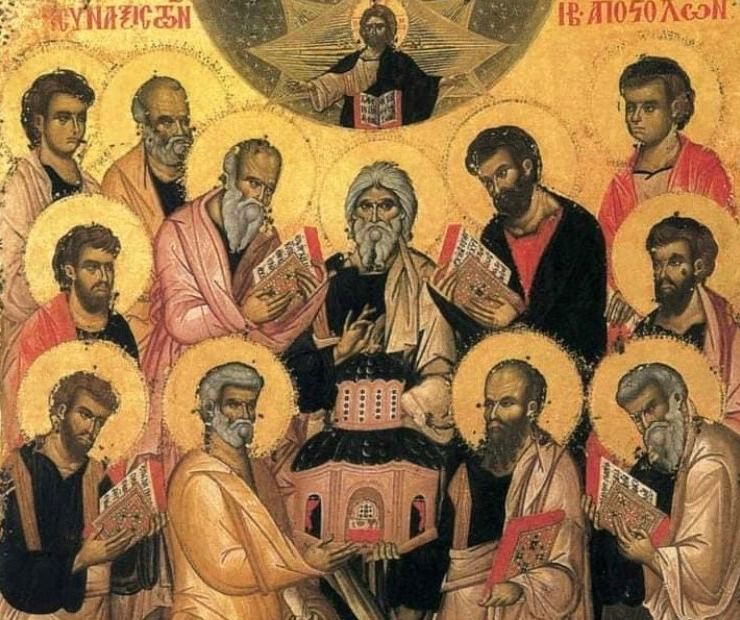
The Mariamite Byzantine Fathers, Byzantine, Society of Mary, is part of the One Holy Catholic Apostolic Church conforms to that of the undivided Catholic Church of the first millennium of its existence. It is expressed in the Symbol of Faith of the Nicene Creed, promulgated by the Council of Nicaea in AD 325 and enlarged by the Council of Constantinople in AD 381:
"I believe in one God, the Father Almighty, maker of Heaven and earth, and of all things visible and invisible, and in one Lord, Jesus Christ, the only begotten Son of God, begotten of the Father before all ages, God of God, Light of Light, true God of true God; begotten, not made; of one essence with the Father, by Whom all things were made, who, for us men, and for our salvation, came down from Heaven, and was incarnate by the Holy Spirit and the Virgin Mary; and became man; He was crucified for us under Pontius Pilate, suffered, and was buried, and the third day He rose again, according to the Scriptures; and ascended into Heaven, and is seated at the right hand of the Father; and He shall come again with glory, to judge the living and the dead; whose Kingdom shall have no end, and in the Holy Spirit, the Lord and giver of life, Who proceed from the Father; Who with the Father and the Son together is worshipped and glorified; Who spoke by the prophets, and in One, Holy, Catholic and Apostolic Church. I acknowledge one Baptism for the remission of sins; I look for the resurrection of the dead, and the life of the world to come. Amen".
Our faith and teachings are based on Saint Gregory the Theologian teaching that upholds his teaching: “I never have and never can honour anything above the Nicene Faith, that of the Holy Fathers who met there to destroy the Arian heresy”.
We believe that the source of our Faith is fully expressed in the Nicene Creed (based on Sacred Scripture and Sacred Tradition). We also believe that Sacred Scripture (the Bible), which comprises the Old Testament and the New Testament, contains God’s revelation to us, particularly that concerning His Son, Our Lord Jesus Christ, and that in matters essential to our salvation.
ON THE BIBLE:
The SM do not consider the Bible to be a source of information concerning science or any other human discipline. Its purpose is to teach us about God and about His Son Jesus Christ. It does that within the cultural environment of its time and place, hence the need for careful study to understand its message correctly.
We hold that Sacred Scripture itself is part of Sacred Tradition, that process by which God’s revelation is passed on to us from the Apostles, and unto the Church Fathers and to the unbroken succession of Bishops through the centuries. This handing on occurs through the prayers and liturgy of the Church, through preaching, teaching, catechesis, devotions, doctrines, and the Bible itself.
The SM believes that Church Tradition is a collection of orthodox practices and beliefs, from the earliest of days, which makes Sacred Tradition an inerrant source of God’s revelation in matters essential to our faith and our Christian life. A very important part of Sacred Tradition is the teaching of the Ecumenical Councils.
The SM believes that the doctrinal definitions of the first Seven Ecumenical Councils, that is those which took place within the undivided catholic Church, were guided by the Holy Spirit and it accepts them as part of its faith. Those seven Ecumenical Councils are the Councils of Nicaea in AD 325, Constantinople in AD 381, Ephesus in AD 431, Chalcedon in AD 451, Constantinople II in AD 533, Constantinople III in AD 680, and Nicaea II in AD 787.These Councils were concerned essentially with defining the true Catholic faith, in the Holy Trinity and in Jesus Christ the Son of God made man: God is triune, a single God in three Persons, Whom the Saviour Himself named as Father, Son and Holy Spirit. Jesus Christ is the Son of God, uniting in His single Person both the divine and the human natures.
The SM believes that equally important in Sacred Tradition are the seven Sacraments. The BSM believes that these Sacraments, which are Baptism and Eucharist, both of which are particularly attested to in Sacred Scripture; Confirmation (or Chrismation), Penance (or Reconciliation), Matrimony, Holy Orders and Unction (or Anointing of the Sick and the Dying), are effective signs of the Lord’s continuing presence and action within His Church and efficacious channels of his Grace. Among the Sacraments, the Holy Eucharist holds prominence of place.
The SM believes that Our Lord Jesus Christ is really and truly present, in His humanity and in His Divinity, in the species of bread and wine that have been consecrated in the Eucharistic Liturgy of the Holy Mass, and that in Holy Communion we receive Him into ourselves to nourish the very life of the soul: ‘Those who eat My Flesh and drink My Blood have eternal life, and I will raise them up on the last day’, (John 6:54).
The SM believes that in Our Lord Jesus’ plan for His Church, the Apostles and the Bishops hold a special place.
The SM believes that the Bishops, canonically and liturgically consecrated in the unbroken line of Apostolic Succession are the successors of the Apostles and that they are responsible, as were the Apostles, for the ministry of service to the Church, consisting of preaching and teaching, of sanctifying and of governing, but most of all, for the safeguarding and the handing-on intact, of the Deposit of Faith and Sacred Tradition of the Church under the divine command.
ON THE BLESSED VIRGIN MARY, THE THEOTOKOS AND THE SAINTS:
The SM believes that Mary, the Mother of Our Lord Jesus Christ, the Theotokos, the Mother of God, the Mother of the Church and the Queen of Heaven and earth, holds a special place in the faith, the lives and the liturgy of the Augustinians Fathers.
ON THE IMMACULATE CONCEPTION:
The SM as the Eastern Orthodox Churches rejects the Catholic dogma of the Immaculate Conception, which defines Mary as conceived without original sin, believing instead that she, like all humans, inherited original sin but was purified later by God's grace through the Holy Spirit, enabling her free-willed "yes" to bear Christ. While Orthodoxy highly venerates the Theotokos (Mother of God) as "all-pure" and sinless in life, they attribute this to her obedience and sanctification, not a special conception, seeing the Catholic doctrine as unnecessary and problematic for free will.
ON THE FULL TITLE OF MARY:
The title Our All-holy, immaculate, most blessed and glorified Lady, the Theotokos and Ever-Virgin Mary.
On the All-Holy:
The title Panagia (all-holy) never was a subject of dogmatic definition, but it is accepted and used by both Catholic and Orthodox Churches. This is because she is the supreme example of cooperation between God and the free will of man. "Behold the handmaid of the Lord; be it unto me according to your word" (Luke 1:38). Sometimes Mary is called the New Eve because her obedient submission to the will of God offset Eve's disobedience in Paradise.
On Being Immaculate:
The Church calls Mary "immaculate," "pure," or "spotless" (achrantos in Greek). It is important that Mary was the same as all mankind so that all Christians can follow her example and submit to God's will. Mary was born a sinner, a human with full human nature. Mary’s Son, Jesus the Christ, took flesh from her. So as Son of God, He assumed fallen human nature from her and redeemed humanity by His Crucifixion and Resurrection.
Most Blessed and Glorified Lady:
The Church honour the Mother of God on account of the Son. St. Cyril of Alexandria, along with the Fathers of the Council of Ephesus, insisted on calling Mary "Theotokos" not just to glorify her, but to safeguard a right doctrine of Christ's person, the Incarnation. Christians feel that one cannot really believe in the Incarnation and not honour Mary.
On the Theotokos:
See above. This is often translated as "the Mother of God."
On the Ever Virgin Mary:
That the Holy Virgin Mary is Ever-Virgin (Aeiparthenos) is not to elevate her to some special status or to incite us to worship the creature rather than the Creator. Rather, it is an affirmation of who Christ Jesus is. Because He has chosen her to be his mother, to conceive Him, to give flesh to Him, to give birth to Him, we understand her as a finite dwelling place of the infinite God. Thus, because she is in this sense this new Holy of Holies, her ever-virginity is a natural characteristic of such an awesome reality.
The whole tradition of the Byzantine Christian Church has always held her to be in truth Ever-Virgin, knowing her personally from the beginning and then passing the truths on from one generation to the next, never expanding nor subtracting from what was known in the beginning. Except for a few instances here and there in history, never have Christians regarded her in any other fashion until relatively late in the Protestant traditions. The Church honour Mary as "ever Virgin." In iconography, her virginity before, during, and after the birth of Christ is represented by three stars on her shoulders and forehead.
ON THE COMMUNION OF SAINTS:
The SM believes in the Communion of Saints, and the fellowship of the whole Church in Glory, the Church Militant and the Church Suffering. It holds to the honouring of Saints, and the prayers for their intercession for both the Church Militant and Suffering.
ON LIFE AFTER DEATH:
Each person is subject to what is called "private judgment" and to what is called "general judgment”.
The private judgment is what an individual receives immediately after death.
The souls of the righteous, who have received a "positive" private judgment have a certain "foretaste" of Heaven, and the souls of unrepentant sinners who received a "negative" private judgment have a "foretaste" of hell.
However, neither Paradise nor the Inferno even exist yet, because the final division of all humans into those who are saints and those who are damned will occur only after the Second Coming of Christ and the general resurrection of the dead (Matthew 25: 31-46).
Even though a person whose soul is separated from his/her body is not able to repent anymore, and thus cannot change the private judgment by him- or herself, the prayers of others, the prayers of the Church, and especially the prayers of the Most Holy Mother of God the Theotokos still can change the destiny of those who received a negative private judgment.
ON THE FILIOQUE POSITION:
We maintain, as does the whole Eastern Orthodox, the solid and unquestioning beliefs as set out in the Creed of Nicaea/Constantinople of AD 381. The BSM maintain that, whilst theological debate may continue regarding the Filioque clause, no Church and no Bishop or Bishops, nor successive Synods or Councils may change, alter, add to, or take away from, a Creed once it is proclaimed by a legitimate General Ecumenical Council, and that such Sacred Tradition is held as absolute by the Augustinians Fathers.
ON THE DIVINE LITURGY:
The authorized Eucharistic Liturgies used by The Mariamite Byzantine Fathers, Society of Mary are; John Chrysostom, Basil the Great and Gregory the Theologian, Pope of Rome.
ON THE SEVEN SACRAMENTS OF THE CHURCH:
We recognize and affirm the Seven Mysteries or Sacraments of the Church:
Baptism.
Chrismation (Confirmation).
Communion (Holy Eucharist).
Holy Ordination.
Penance.
Anointing of the sick (Holy Unction of the sick and Extreme Unction for the dying).
Holy Matrimony / Marriage.
"I believe in one God, the Father Almighty, maker of Heaven and earth, and of all things visible and invisible, and in one Lord, Jesus Christ, the only begotten Son of God, begotten of the Father before all ages, God of God, Light of Light, true God of true God; begotten, not made; of one essence with the Father, by Whom all things were made, who, for us men, and for our salvation, came down from Heaven, and was incarnate by the Holy Spirit and the Virgin Mary; and became man; He was crucified for us under Pontius Pilate, suffered, and was buried, and the third day He rose again, according to the Scriptures; and ascended into Heaven, and is seated at the right hand of the Father; and He shall come again with glory, to judge the living and the dead; whose Kingdom shall have no end, and in the Holy Spirit, the Lord and giver of life, Who proceed from the Father; Who with the Father and the Son together is worshipped and glorified; Who spoke by the prophets, and in One, Holy, Catholic and Apostolic Church. I acknowledge one Baptism for the remission of sins; I look for the resurrection of the dead, and the life of the world to come. Amen".
Our faith and teachings are based on Saint Gregory the Theologian teaching that upholds his teaching: “I never have and never can honour anything above the Nicene Faith, that of the Holy Fathers who met there to destroy the Arian heresy”.
We believe that the source of our Faith is fully expressed in the Nicene Creed (based on Sacred Scripture and Sacred Tradition). We also believe that Sacred Scripture (the Bible), which comprises the Old Testament and the New Testament, contains God’s revelation to us, particularly that concerning His Son, Our Lord Jesus Christ, and that in matters essential to our salvation.
ON THE BIBLE:
The SM do not consider the Bible to be a source of information concerning science or any other human discipline. Its purpose is to teach us about God and about His Son Jesus Christ. It does that within the cultural environment of its time and place, hence the need for careful study to understand its message correctly.
We hold that Sacred Scripture itself is part of Sacred Tradition, that process by which God’s revelation is passed on to us from the Apostles, and unto the Church Fathers and to the unbroken succession of Bishops through the centuries. This handing on occurs through the prayers and liturgy of the Church, through preaching, teaching, catechesis, devotions, doctrines, and the Bible itself.
The SM believes that Church Tradition is a collection of orthodox practices and beliefs, from the earliest of days, which makes Sacred Tradition an inerrant source of God’s revelation in matters essential to our faith and our Christian life. A very important part of Sacred Tradition is the teaching of the Ecumenical Councils.
The SM believes that the doctrinal definitions of the first Seven Ecumenical Councils, that is those which took place within the undivided catholic Church, were guided by the Holy Spirit and it accepts them as part of its faith. Those seven Ecumenical Councils are the Councils of Nicaea in AD 325, Constantinople in AD 381, Ephesus in AD 431, Chalcedon in AD 451, Constantinople II in AD 533, Constantinople III in AD 680, and Nicaea II in AD 787.These Councils were concerned essentially with defining the true Catholic faith, in the Holy Trinity and in Jesus Christ the Son of God made man: God is triune, a single God in three Persons, Whom the Saviour Himself named as Father, Son and Holy Spirit. Jesus Christ is the Son of God, uniting in His single Person both the divine and the human natures.
The SM believes that equally important in Sacred Tradition are the seven Sacraments. The BSM believes that these Sacraments, which are Baptism and Eucharist, both of which are particularly attested to in Sacred Scripture; Confirmation (or Chrismation), Penance (or Reconciliation), Matrimony, Holy Orders and Unction (or Anointing of the Sick and the Dying), are effective signs of the Lord’s continuing presence and action within His Church and efficacious channels of his Grace. Among the Sacraments, the Holy Eucharist holds prominence of place.
The SM believes that Our Lord Jesus Christ is really and truly present, in His humanity and in His Divinity, in the species of bread and wine that have been consecrated in the Eucharistic Liturgy of the Holy Mass, and that in Holy Communion we receive Him into ourselves to nourish the very life of the soul: ‘Those who eat My Flesh and drink My Blood have eternal life, and I will raise them up on the last day’, (John 6:54).
The SM believes that in Our Lord Jesus’ plan for His Church, the Apostles and the Bishops hold a special place.
The SM believes that the Bishops, canonically and liturgically consecrated in the unbroken line of Apostolic Succession are the successors of the Apostles and that they are responsible, as were the Apostles, for the ministry of service to the Church, consisting of preaching and teaching, of sanctifying and of governing, but most of all, for the safeguarding and the handing-on intact, of the Deposit of Faith and Sacred Tradition of the Church under the divine command.
ON THE BLESSED VIRGIN MARY, THE THEOTOKOS AND THE SAINTS:
The SM believes that Mary, the Mother of Our Lord Jesus Christ, the Theotokos, the Mother of God, the Mother of the Church and the Queen of Heaven and earth, holds a special place in the faith, the lives and the liturgy of the Augustinians Fathers.
ON THE IMMACULATE CONCEPTION:
The SM as the Eastern Orthodox Churches rejects the Catholic dogma of the Immaculate Conception, which defines Mary as conceived without original sin, believing instead that she, like all humans, inherited original sin but was purified later by God's grace through the Holy Spirit, enabling her free-willed "yes" to bear Christ. While Orthodoxy highly venerates the Theotokos (Mother of God) as "all-pure" and sinless in life, they attribute this to her obedience and sanctification, not a special conception, seeing the Catholic doctrine as unnecessary and problematic for free will.
ON THE FULL TITLE OF MARY:
The title Our All-holy, immaculate, most blessed and glorified Lady, the Theotokos and Ever-Virgin Mary.
On the All-Holy:
The title Panagia (all-holy) never was a subject of dogmatic definition, but it is accepted and used by both Catholic and Orthodox Churches. This is because she is the supreme example of cooperation between God and the free will of man. "Behold the handmaid of the Lord; be it unto me according to your word" (Luke 1:38). Sometimes Mary is called the New Eve because her obedient submission to the will of God offset Eve's disobedience in Paradise.
On Being Immaculate:
The Church calls Mary "immaculate," "pure," or "spotless" (achrantos in Greek). It is important that Mary was the same as all mankind so that all Christians can follow her example and submit to God's will. Mary was born a sinner, a human with full human nature. Mary’s Son, Jesus the Christ, took flesh from her. So as Son of God, He assumed fallen human nature from her and redeemed humanity by His Crucifixion and Resurrection.
Most Blessed and Glorified Lady:
The Church honour the Mother of God on account of the Son. St. Cyril of Alexandria, along with the Fathers of the Council of Ephesus, insisted on calling Mary "Theotokos" not just to glorify her, but to safeguard a right doctrine of Christ's person, the Incarnation. Christians feel that one cannot really believe in the Incarnation and not honour Mary.
On the Theotokos:
See above. This is often translated as "the Mother of God."
On the Ever Virgin Mary:
That the Holy Virgin Mary is Ever-Virgin (Aeiparthenos) is not to elevate her to some special status or to incite us to worship the creature rather than the Creator. Rather, it is an affirmation of who Christ Jesus is. Because He has chosen her to be his mother, to conceive Him, to give flesh to Him, to give birth to Him, we understand her as a finite dwelling place of the infinite God. Thus, because she is in this sense this new Holy of Holies, her ever-virginity is a natural characteristic of such an awesome reality.
The whole tradition of the Byzantine Christian Church has always held her to be in truth Ever-Virgin, knowing her personally from the beginning and then passing the truths on from one generation to the next, never expanding nor subtracting from what was known in the beginning. Except for a few instances here and there in history, never have Christians regarded her in any other fashion until relatively late in the Protestant traditions. The Church honour Mary as "ever Virgin." In iconography, her virginity before, during, and after the birth of Christ is represented by three stars on her shoulders and forehead.
ON THE COMMUNION OF SAINTS:
The SM believes in the Communion of Saints, and the fellowship of the whole Church in Glory, the Church Militant and the Church Suffering. It holds to the honouring of Saints, and the prayers for their intercession for both the Church Militant and Suffering.
ON LIFE AFTER DEATH:
Each person is subject to what is called "private judgment" and to what is called "general judgment”.
The private judgment is what an individual receives immediately after death.
The souls of the righteous, who have received a "positive" private judgment have a certain "foretaste" of Heaven, and the souls of unrepentant sinners who received a "negative" private judgment have a "foretaste" of hell.
However, neither Paradise nor the Inferno even exist yet, because the final division of all humans into those who are saints and those who are damned will occur only after the Second Coming of Christ and the general resurrection of the dead (Matthew 25: 31-46).
Even though a person whose soul is separated from his/her body is not able to repent anymore, and thus cannot change the private judgment by him- or herself, the prayers of others, the prayers of the Church, and especially the prayers of the Most Holy Mother of God the Theotokos still can change the destiny of those who received a negative private judgment.
ON THE FILIOQUE POSITION:
We maintain, as does the whole Eastern Orthodox, the solid and unquestioning beliefs as set out in the Creed of Nicaea/Constantinople of AD 381. The BSM maintain that, whilst theological debate may continue regarding the Filioque clause, no Church and no Bishop or Bishops, nor successive Synods or Councils may change, alter, add to, or take away from, a Creed once it is proclaimed by a legitimate General Ecumenical Council, and that such Sacred Tradition is held as absolute by the Augustinians Fathers.
ON THE DIVINE LITURGY:
The authorized Eucharistic Liturgies used by The Mariamite Byzantine Fathers, Society of Mary are; John Chrysostom, Basil the Great and Gregory the Theologian, Pope of Rome.
ON THE SEVEN SACRAMENTS OF THE CHURCH:
We recognize and affirm the Seven Mysteries or Sacraments of the Church:
Baptism.
Chrismation (Confirmation).
Communion (Holy Eucharist).
Holy Ordination.
Penance.
Anointing of the sick (Holy Unction of the sick and Extreme Unction for the dying).
Holy Matrimony / Marriage.